Plainly
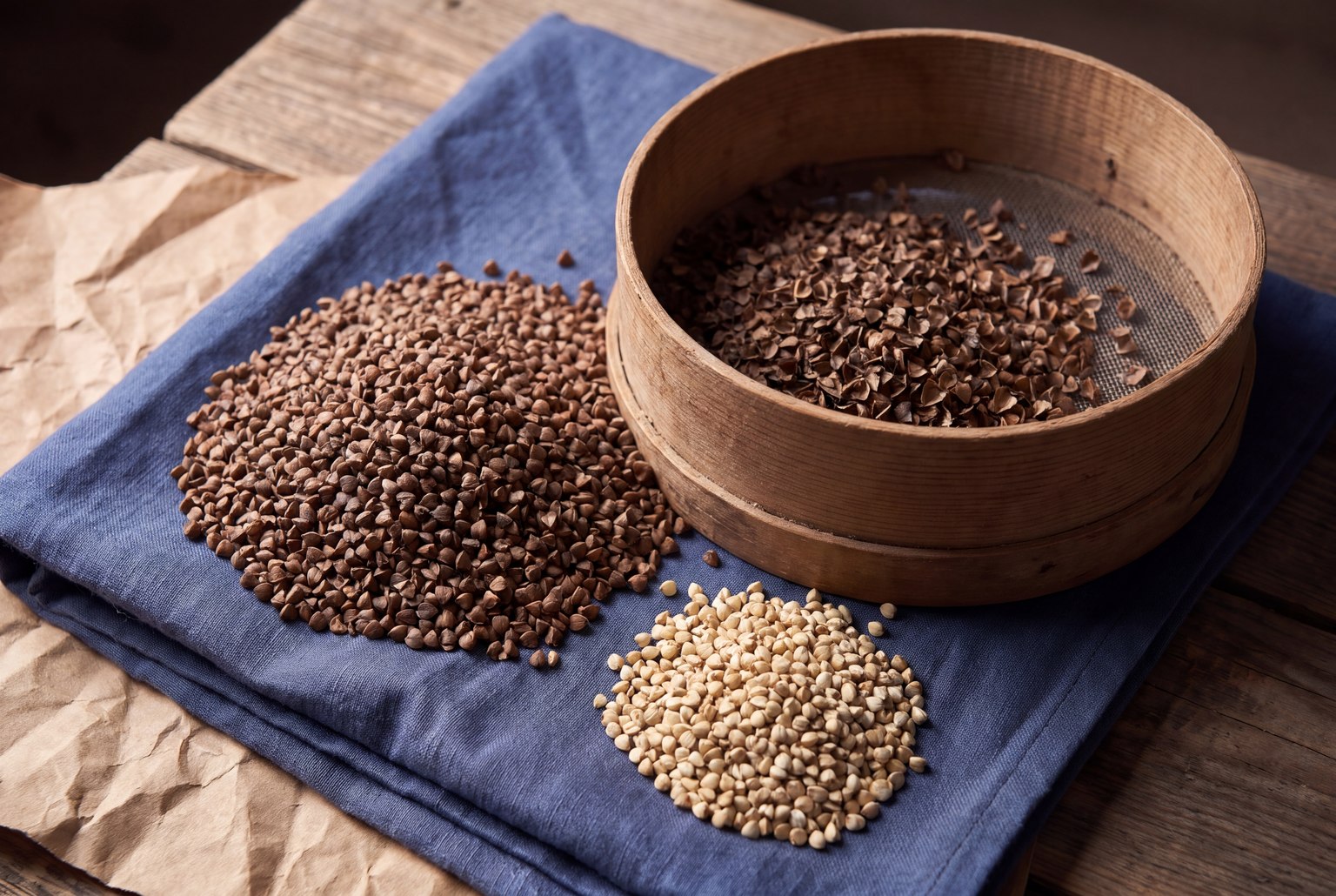
A mill cleans the whole grain, sorts it by size, then cracks each seed by impact or between stones. An air stream lifts the light hulls off the heavy groats. Hulls are roughly 22 to 30% of the grain's weight (Molecules, 2022; Sinkovič et al., 2022). They leave the food line dusty, so the fill you buy needs a second pass of air cleaning and sifting through screens. A few sellers also wash, heat or polish the hulls.
This guide is for: people filling a pillow from loose hulls, and anyone who wants to know what the cleaning claims on a bag of hulls describe.
Key Takeaways
Three facts carry the whole process: how much of the seed is hull, why mill hulls are not yet fill, and what sellers say they do.
- Hulls make up roughly 22 to 30% of the grain's weight in published studies. A mill frees them by impact or between stones, and then an air stream lifts them off the heavier groats (Molecules, 2022; Sinkovič et al., 2022).
- Hulls leave the food mill dusty. A New York mill with more than 220 years of grain milling (The Birkett Mills) says its hulls are not cleaned again and are sold as feed or mulch (The Birkett Mills FAQ).
- Of 10 pages we read on November 10, 2026, 5 named how the dust is removed, 4 claimed cleaning without saying how, and 1 said its hulls are not cleaned for pillow use.
What happens to buckwheat before the hull comes off?
Before any hull is removed, the whole grain is cleaned of field trash and sorted by size, because each size needs a different gap.
Grain comes off the combine with stems, weed seed and empty shells mixed in. At a 1997 field day for New York growers, a buyer for a large mill said some loads arrive half empty hulls by volume, though far less by weight (Cornell Northeast Buckwheat Growers Newsletter, 1997). The same newsletter warned that sticks, dust, pollen and mold are common in farm screenings, so those screenings never become fill. In the newsletter's words, clean hulls come only from separating whole kernels, hulling them and then removing the dust. The order matters: the seed is cleaned first and opened later.
Next, the clean grain is graded by size. A huller works at a fixed gap. A gap that suits large seed lets small seed slip through whole. A gap set for small seed crushes the large ones, and crushed seed means crushed hulls in your pillow.
Some mills heat or steam the grain first. One dehulling study describes seed that is heated, then cooled, conditioned and dried before the shell comes off (dehulling study, PubMed Central). Other lines hull the grain cold. For you, the useful point is that the shape of the hulls in your pillow is partly settled here, long before anyone has thought about pillows. Your pillow inherits that choice.
How does a mill crack the hull away from the groat?
A spinning rotor throws each seed against a hard ring, or two stones rub it, and the shell breaks loose from the kernel inside.
Two kinds of machine do most of this work. An impact huller throws the grain against a hard surface at high speed, so the hull comes apart (eOrganic). One maker's page describes a fast rotor that flings seed against a hard ring (Addams impact dehuller). A stone or disc huller rubs seed between a fixed surface and a turning one, the kind of mill a Slovenian study used (Sinkovič et al., 2022).
Both machines leave some seed whole after one pass. The impact maker's page says its output is a mix of free kernels, loose hulls and a small share of seed that is still whole. Variety matters too. In a study of Tartary buckwheat, one variety hulled at 93% efficiency while another managed only 2 to 6% (Tartary hull study, PubMed Central). Grain still in its hull goes back to the start of the line for another pass (eOrganic).
The hull makes up a large share of each load. One study puts it at about 22% of the mass of processed grain (Molecules, 2022). The Slovenian stone-mill study recovered about 30% hulls from common buckwheat and about 40% from Tartary buckwheat (Sinkovič et al., 2022). So the bag of fill you buy stands for roughly three to four and a half times its weight in whole grain. That ratio is our own arithmetic from those shares, and no mill has published it.
How are loose hulls separated from the groats?
Air does most of the work: a rising stream lifts the light, hollow hulls and lets the dense groats fall, then screens sort what is left.
Weight does the sorting. A hull is a hollow shell and a groat is solid seed. Moving air can tell them apart. Air rises through the falling stream, and hulls and dust ride up and out while groats and whole seed drop.
Air alone leaves a mixed heavy stream. One huller maker says separate aspiration and screening equipment may be needed after hulling, to sort kernels, hull fragments, broken product and grain that stayed whole (MMCtech dehuller page).
| Stage | What goes in | What comes out | What happens to the hulls |
|---|---|---|---|
| Grain cleaning | Field grain with trash | Clean whole seed | Screenings are thrown out |
| Size grading | Clean whole seed | Seed in size bands | Still on the seed |
| Hulling | One size band | Groats, hulls, unopened seed | Mixed with the groats |
| Aspiration | The mixed stream | Light and heavy fractions | Hulls and dust leave with the air |
| Screening | The heavy fraction | Whole and broken groats, unopened seed | Stray pieces are pulled out |
The table follows the order in the Cornell newsletter and the machine pages cited above. Every step serves the groats, not the hull. For you, that means the hulls leaving this stage are a leftover, and they still carry the mill's dust.
Are buckwheat hulls cleaned after they leave the mill?
Usually not by the food mill. Hulls leave the food line with dust and flour on them, so pillow fill needs a second cleaning run of its own.
A food mill has no reason to clean what it throws away. The Birkett Mills says that once hulls come off the groat, they are not cleaned again. They go to a bin with other discarded hulls and are typically very dusty (The Birkett Mills FAQ). The mill sells them as feed or mulch and does not recommend them as pillow stuffing. The same FAQ says organic and conventional hulls share that bin. That is why an organic claim on your hulls needs its own chain from field to bag, which our page on what makes a buckwheat pillow organic covers.
Pillow makers do not always add that step. The authors of a 2004 Korean study wrote that hulls for Korean pillows were not normally cleaned, while US pillow hulls normally were cleaned extensively (Nam et al., 2004).
That makes the fill you buy a chosen fraction. Someone buys the hulls and runs them through a second line built for them. Sellers describe that line with the same two tools the mill used: moving air and screens. Air carries off dust and flour, which are lighter than a whole hull. Screens drop fine broken pieces and hold back anything too big. Your bag needs that second run.
Separation is never perfect in either direction. Missouri Extension notes that dark specks in buckwheat flour are usually bits of hull that were not fully removed (University of Missouri Extension). You can expect the reverse in a bag of hulls: a little flour, unless the second line is thorough.
What does triple cleaned mean on a bag of hulls?
It means three passes, but almost no page says what each pass is. Our count of 10 published pages shows how often the method is named.
We read 10 published pages on November 10, 2026: 9 product or FAQ pages from sellers of hulls or hull pillows, and 1 FAQ page from a buckwheat mill. We sorted each page by what it states about cleaning. The count comes from reading alone. We did not weigh, sift or test any hulls for it.
| What the page states | Pages | Count |
|---|---|---|
| Names the cleaning method (air, air washing, screen sifting, vacuuming, or screening plus washing, heat and UV) | Bean Products, Hullo, PineTales, The Perfect Pillow, Comfort Traditions | 5 |
| Claims cleaning but names no step (triple cleaned, 3x cleaned, dusted and clean) | Monterey Bay Herb Co., Bucky, FitMe, Buckwheat Bedding | 4 |
| Says its hulls are not cleaned for pillow use | The Birkett Mills | 1 |
Triple cleaned counts passes but does not define them. Every page in our count leaves the term undefined, with no test named behind it. Only one gives a dust figure: Bucky calls its hulls 99.9% dust free without saying how that was found (Bucky). When you compare bags, a page that names air and screens tells you more than a page that only counts passes. A silent page may still sell clean hulls. You just cannot tell from reading it.
Do some sellers wash, heat or polish the hulls too?
A few do. Washing, heat, UV and polishing are extra steps after air and screens, and sellers disagree about whether hulls should ever get wet.
Seller pages split over the extra steps. PineTales says its hulls are triple screened, washed, then treated with heat and UV light (PineTales). Bucky's FAQ tells people to never wash any grain or grain hull filling (Bucky FAQ). Both positions can hold. Drying hulls in a plant is not the same as soaking your pillow at home. Our page on how to clean a buckwheat pillow and whether the hulls can get wet covers the home side.
Roasting is the other split. Hullo says its hulls are never roasted and sets them against roasted, crumbly imported hulls (Hullo). Polishing rubs hulls into smoother pieces, which our page on what polishing changes in a buckwheat hull explains. If a bag lists these steps, you can read the table below to see what each one is for.
| Step | What it removes | What it leaves | Our reading |
|---|---|---|---|
| Air cleaning | Loose dust, flour, chaff | Fines lodged inside hulls | The core step |
| Screen sifting | Broken bits that fall through | Dust clinging to whole hulls | Needs air alongside it |
| Washing | Dust that air misses | Moisture, unless fully dried | Only sound where drying is controlled |
| Heat or UV | Aimed at microbes, not dust | Everything else | A hygiene step, not cleaning |
| Polishing | Sharp edges, some surface dust | Smaller, flatter pieces | Changes feel more than cleanliness |
This table is our judgement from the pages cited here. No maker publishes it.
Why does dust left in the fill matter?
Dust is the part of a hull pillow you breathe. One study found new hull pillows carried far more bacterial endotoxin than synthetic ones.
A pillow sits beside your face all night. You breathe whatever the fill sheds. The clearest study comes from Korea. Researchers followed new synthetic and buckwheat pillows over three months and found more than 10-fold higher endotoxin on the buckwheat pillows (Nam et al., Journal of Korean Medical Science, 2004). Endotoxin comes from the cell walls of bacteria. The authors said the high levels most likely came from the fill, and they traced it most likely to buckwheat flour residue on hulls that had not been cleaned. That residue is what the processing on this page is meant to remove.
Read that with care. It was one study, of Korean pillows, more than 20 years ago. It does not show that every bag of hulls you might buy carries the same load. It does show why the second cleaning line exists.
Cleaning has a limit. It removes dust, but it cannot remove buckwheat. A review of buckwheat allergy studies says these pillows can expose you to airborne buckwheat allergens while you sleep, and it describes a Beijing allergy clinic that identified seven patients with buckwheat allergy, five of whom used buckwheat hull pillows (Norbäck and Wieslander, 2021). If you are allergic to buckwheat, no cleaning claim makes this fill safe for you. Broken hulls matter over time as well, since each crushed piece sheds fine particles of its own.
Can you separate and clean buckwheat hulls at home?
You can, but a kitchen mill can crack many hulls and the yield is small. Buying cleaned hulls and sifting them once more is the simpler route.
It takes patience. One writer bought unhulled buckwheat, ran it through a household grain mill on a coarse setting, then sifted the hulls from the flour several times (Traditional Cooking School). The writer found that a coarser grind separated the hulls more cleanly. The method suits a small pillow but gets hard when you scale it to a bed pillow.
Yield is the problem. Hullo says its 10-pound bag is more than enough for any standard bed pillow (Hullo). Hulls are a fraction of the grain. So you would need to mill several times that weight of whole buckwheat to fill one case. A kitchen mill also cracks some hulls. Cracked pieces pack flatter and shed more dust.
If you buy cleaned hulls, you can give them one more pass outdoors. Pour them slowly through a colander or garden riddle and let a light breeze carry off what floats. That copies the mill's two tools, air and screens, on a small scale. It is a suggested approach that we have not tested.
Volume helps you plan. Monterey Bay Herb Co. lists 1 lb of hulls as 200 cubic inches, or 13.8 cups (Monterey Bay Herb Co.). Keep the hulls dry the whole time. A sink rinse undoes the work.
Common questions
Short answers to the questions that come up about how hulls are cleaned, sifted and checked before they go into a pillow case.
Are buckwheat hulls cleaned before they go in a pillow?
Pillow sellers say theirs are, usually with air and screens. The mill that frees the hull does not clean it again, so the cleaning is a separate job. In our count, 9 of 10 pages claimed some cleaning, and 5 of them named how it was done.
Are the hulls in a pillow washed with water?
Most of the seller pages we read describe air rather than water. One seller says it washes its hulls and then treats them with heat and UV. At home, you should keep the hulls dry and wash only the case.
What is left in hulls that were not cleaned well?
Dust, flour, chaff and broken hull pieces, plus stems or weed seed if the grain was not cleaned before hulling. A Korean study found very high endotoxin on new buckwheat pillows and traced it most likely to the fill (Nam et al., 2004).
How many pounds of hulls fill a standard pillow?
Hullo says its 10-pound bag is more than enough for a standard bed pillow (Hullo). The amount you need depends on the height your head needs, which this site's sizing pages cover separately.
Does cleaning make hulls safe for a buckwheat allergy?
No. Cleaning takes out dust, not buckwheat. A review of buckwheat allergy studies describes clinic patients who slept on buckwheat hull pillows. If buckwheat food gives you a reaction, ask your doctor before you sleep on this fill.
Why do some bags say never roasted?
Some sellers contrast their hulls with roasted imported hulls, which they describe as crumbly. The pages we read give no test or figure behind the claim. You can treat it as a description of that seller's supply rather than a standard.
Sources
Hull pillow references used above, with the heading under which each one is cited.
- Molecules, 2022 (ncbi.nlm.nih.gov), under “Key Takeaways”; “How does a mill crack the hull away from the groat?”.
- Sinkovič et al., 2022 (ncbi.nlm.nih.gov), under “Key Takeaways”; “How does a mill crack the hull away from the groat?”.
- The Birkett Mills (thebirkettmills.com), under “Key Takeaways”.
- The Birkett Mills FAQ (thebirkettmills.com), under “Key Takeaways”; “Are buckwheat hulls cleaned after they leave the mill?”; “What does triple cleaned mean on a bag of hulls?”.
- Cornell Northeast Buckwheat Growers Newsletter, 1997 (hort.cornell.edu), under “What happens to buckwheat before the hull comes off?”.
- dehulling study, PubMed Central (ncbi.nlm.nih.gov), under “What happens to buckwheat before the hull comes off?”.
- eOrganic (eorganic.org), under “How does a mill crack the hull away from the groat?”.
- Addams impact dehuller (addamsgroup.com), under “How does a mill crack the hull away from the groat?”.
- Tartary hull study, PubMed Central (ncbi.nlm.nih.gov), under “How does a mill crack the hull away from the groat?”.
- MMCtech dehuller page (mmctech.us), under “How are loose hulls separated from the groats?”.
- Nam et al., 2004 (ncbi.nlm.nih.gov), under “Are buckwheat hulls cleaned after they leave the mill?”; “Why does dust left in the fill matter?”; “Common questions”.
- University of Missouri Extension (extension.missouri.edu), under “Are buckwheat hulls cleaned after they leave the mill?”.
- Bean Products (beanproducts.com), under “What does triple cleaned mean on a bag of hulls?”.
- Hullo (hullopillow.com), under “What does triple cleaned mean on a bag of hulls?”; “Do some sellers wash, heat or polish the hulls too?”; “Can you separate and clean buckwheat hulls at home?”; “Common questions”.
- PineTales (pinetales.com), under “What does triple cleaned mean on a bag of hulls?”; “Do some sellers wash, heat or polish the hulls too?”.
- The Perfect Pillow (perfectpillow.com), under “What does triple cleaned mean on a bag of hulls?”.
- Comfort Traditions (comfort-traditions.com), under “What does triple cleaned mean on a bag of hulls?”.
- Monterey Bay Herb Co. (herbco.com), under “What does triple cleaned mean on a bag of hulls?”; “Can you separate and clean buckwheat hulls at home?”.
- Bucky (bucky.com), under “What does triple cleaned mean on a bag of hulls?”.
- FitMe (fitmepillow.com), under “What does triple cleaned mean on a bag of hulls?”.
- Buckwheat Bedding (buckwheatbedding.com), under “What does triple cleaned mean on a bag of hulls?”.
- Bucky FAQ (bucky.com), under “Do some sellers wash, heat or polish the hulls too?”.
- Norbäck and Wieslander, 2021 (ncbi.nlm.nih.gov), under “Why does dust left in the fill matter?”.
- Traditional Cooking School (traditionalcookingschool.com), under “Can you separate and clean buckwheat hulls at home?”.