Plainly
Pour the hulls into a dry container and wash the empty cover cold. Refill only when the cover is fully dry. Clean the hulls by spreading them thin in sun or moving air. Never soak them. If hulls get splashed, get them out and dry them fast, since the EPA's general rule is to dry water-damaged items within 24 to 48 hours (EPA). No seller care page we read says to wash hulls in water at home.
This guide is for: anyone who owns a buckwheat or sobakawa pillow and wants it clean without ruining the hulls.
Key Takeaways
This page rests on these points: only fabric goes in water, damp hulls must dry fast, and sellers split on how to rescue wet ones.
- Only the fabric goes in water. Pour the hulls into a dry container first, then wash the empty cover cold. One seller puts "cold" at 75 to 85°F and says to air-dry the cover instead of tumbling it (Hullo).
- Damp hulls are on a clock. The EPA's general rule is to dry water-damaged items within 24 to 48 hours to prevent mold, so spread wet hulls thin the same day (EPA). If yours are still damp after that, replace them.
- Sellers agree on the ban but not on the rescue. We read 9 seller care pages on October 20, 2026. Of those, 3 say to dry wet hulls, 3 say to dry or replace them depending on how wet they got, and 3 give no step for wet hulls at all.
The rest of the page takes these points one at a time. It starts with the washing machine and ends with how Japanese owners care for the same pillow.
Have a wet pillow in front of you right now? Skip to the wet-hull question. A musty smell or spots on the hulls point to a mold question rather than a cleaning one. That question has its own page in the guides.
Can you wash a buckwheat pillow in the washing machine?
Not the whole pillow. The cover goes in the machine once it is empty, but the hulls stay out of the drum and out of water entirely.
You can machine-wash the fabric parts of a buckwheat pillow and nothing else. The whole pillow, hulls and all, should never go in the washer. Every seller page we read has you empty the hulls first. J-Life says buckwheat should never touch water. Water makes the hulls soften, lose their shape and grow mold (J-Life). A ZEN CHI refill listing says soaking ruins the hulls' structure and can lead to mold (ZEN CHI on Amazon).
The dryer doesn't help either. Hullo warns that heat dries hulls out until they turn brittle, and brittle hulls break down faster (Hullo).
So you can wash a sobakawa pillow, one part at a time. Here is how each part is handled.
| Part | Can it get wet? | How to clean it |
|---|---|---|
| Pillowcase over the pillow | Yes | Wash it with your sheets |
| Zippered cover, emptied | Yes | Cold, gentle cycle, then dry fully |
| Inner hull bag, if there is one | Only once emptied | Treat it like the cover |
| Loose hulls | No | Air them in a thin layer |
Your pillow may have an inner bag. Sachi Organics, for one, tells you to take the hull-filled inner bag out and wash only the outer cover (Sachi Organics). Without a zipper, you can't separate the fill from the fabric. Then the whole pillow stays out of the water. Airing it is the only option.
How do you wash the cover without wetting the hulls?
Empty every hull into a dry container, wash the cover cold, and refill only when the fabric is completely dry, not just dry to the touch.
Your skin oils and sweat collect on the cover. That part gets a real wash. The rule is that no hull goes in the machine, and no damp fabric goes back around the hulls.
- Empty it. Stand the pillow on end with the zipper up, then pour or scoop the hulls out. Hullo suggests a paper grocery bag because it holds its shape while you pour (Hullo).
- Clear the corners. Turn the cover inside out and shake it over the bag. Hulls left in the seams end up inside your washer.
- Wash cold. Hullo defines cold as 75 to 85°F and says to air-dry its cotton cover. J-Life lets its cotton covers go in the dryer on low heat (J-Life). Follow your own seller's label.
- Dry it all the way. PineTales lists putting damp fabric back around the hulls as a common mistake (PineTales). Seams hold water longer than the flat fabric, so check them before you refill.
- Refill over a sheet. Hulls bounce and scatter if you pour onto a hard floor. Hullo's tip is to have one person pour while the other holds the cover open.
The whole job takes one wash cycle plus drying time. Most of that wait goes to letting the cover dry. Start early in the day.
How do you clean the hulls if they cannot be washed?
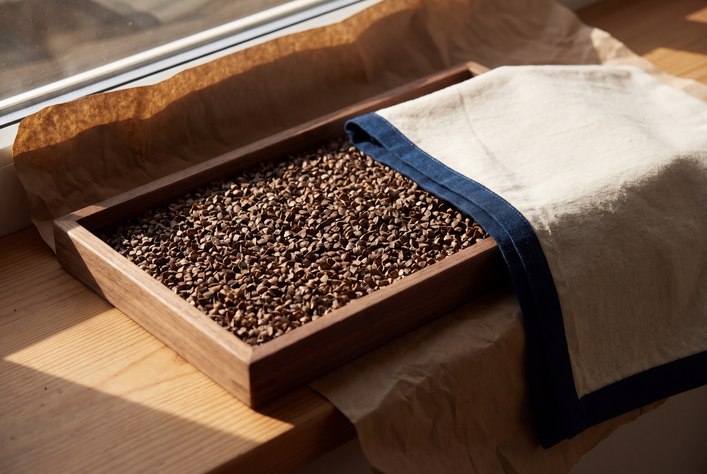
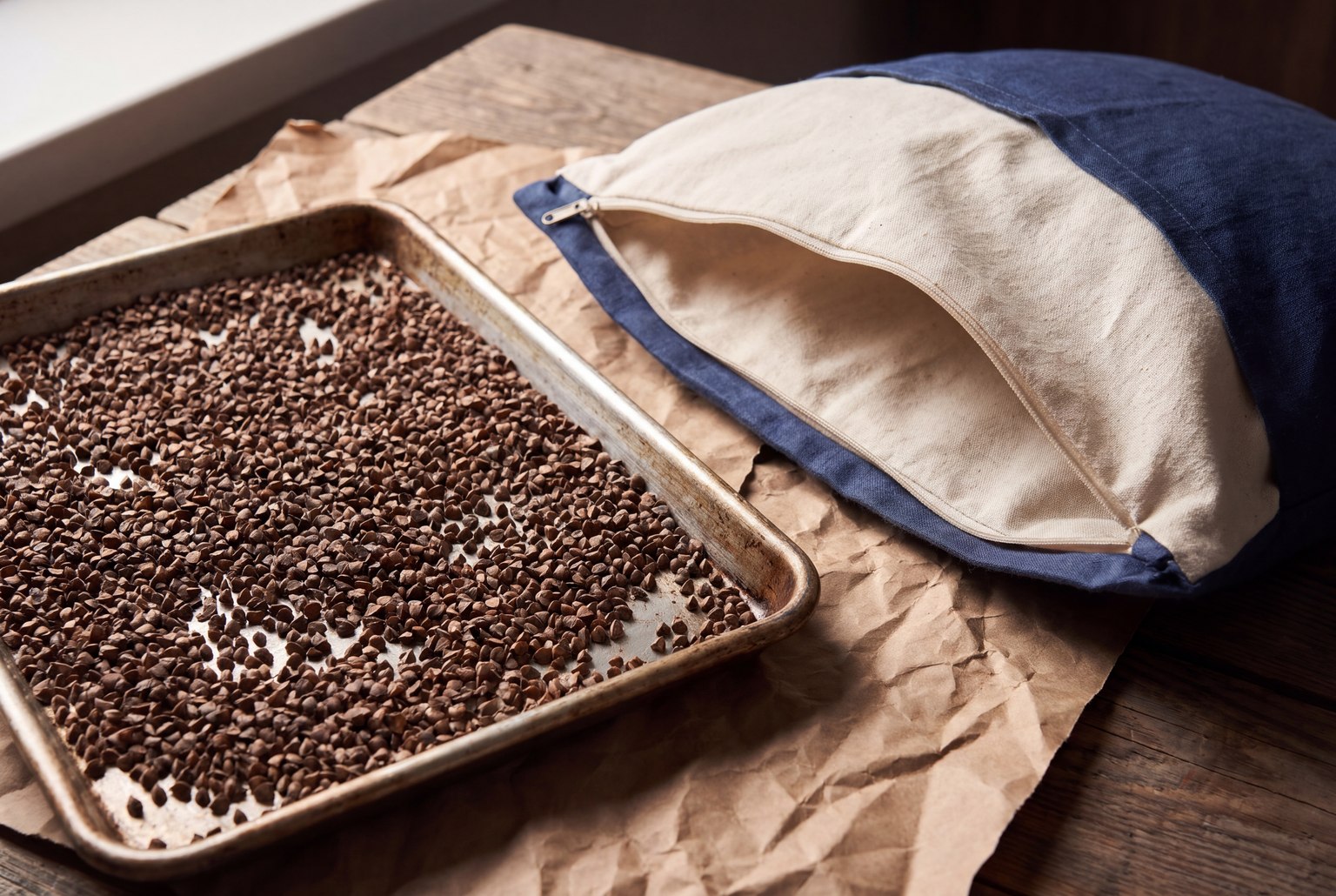
You air them instead of washing them. Spread the hulls thin in sun or moving air for a few hours, pick out the debris, then pour them back.
You clean hulls with air and light, not water. Sellers describe the same short routine. Sweet Zzz says to pour the hulls onto a baking sheet or clean tarp and look them over. It says to remove dirt and damaged pieces, then leave them in the sun for a few hours (Sweet Zzz). J-Life uses the same sun method. It says once or twice a year is enough. Hullo says a clean cover means little worry about the hulls inside. For hulls that do pick up moisture or odor, it suggests gently moving air indoors, ideally in sunlight (Hullo).
Spread the hulls one or two deep, not in a heap. If you heap them, the middle stays shaded and damp. Stir the hulls once or twice so the bottom layer gets air too. That step is our judgement, not a seller's instruction.
Don't overdo the drying. A Japanese bedding seller's guide suggests 1 to 2 hours of sun at a time. It warns that longer exposure dries hulls until they crack (Goosely). Hullo makes the same point about microwaves.
The fine dust at the bottom of the bag is broken hull. Tip it out before you refill. If a lot builds up, the hulls are wearing down. Sachi Organics notes that hulls can be topped up over time, which brings the pillow back to its height.
Why do sellers say the hulls must never get wet?
Hulls take up water fast and dry slowly when packed together, and in stored grain, mold can take over once moisture passes about 15%.
There are two reasons, and only one is about germs. The first is shape. J-Life says water makes hulls soften and lose their form. Soft hulls can't hold your head at the height they used to. The fill depends on each hull's stiff, cupped shape, as What is a buckwheat hull, and why does its shape matter? explains.
The second is mold. A 2021 study of hull filling for mattresses found that it takes up moisture very quickly (IJERPH, 2021). The authors tested hulls at 9% moisture. Citing earlier grain research, they note that mold can take over once grain moisture passes 15%. They add that Penicillium fungi usually settle on seeds above 17%. The FAO's storage manual says fungi start to grow when air humidity goes above 65 to 70% (FAO).
| Figure | What it describes | Source |
|---|---|---|
| 9% | Moisture of the dry hulls the study tested | IJERPH, 2021 |
| Over 15% | Grain moisture at which mold can take over | IJERPH, 2021 |
| Over 17% | Seed moisture where Penicillium usually settles | IJERPH, 2021 |
| Over 65 to 70% | Air humidity where fungi start growing on stored produce | FAO |
None of these figures was measured on a pillow. Together, they explain why sellers are so cautious. A spill pushes hulls far past their dry state. PineTales warns that wet hulls are hard to dry properly. Mold and bugs in a used pillow are a separate question, answered in Can a buckwheat pillow get moldy or bring bugs into your bed?
What should you do if the hulls get wet by accident?
Act the same day. Get the wet hulls out, spread them thin to dry, and replace them if they were soaked or the liquid was not plain water.
Speed matters more than how you dry. Open the cover as soon as you notice, and check whether the hulls themselves got wet. J-Life's first step is the same: take off every layer and check the fill (J-Life). If only the fabric is wet, empty the hulls and deal with the cover.
Wet hulls are a judgement call. Sellers go by how much got wet and with what. Hullo says hulls from a plain water spill can be good as new if you dry them quickly. For beer or soda it recommends replacement hulls (Hullo). J-Life sun-dries hulls that took on a small amount of moisture. It says to throw soaked ones out. PineTales says replacement may be the safer choice once liquid gets into the fill (PineTales).
| What got wet | Reasonable step |
|---|---|
| Cover only, hulls dry | Empty the hulls, wash the cover, refill when dry |
| A handful of hulls, plain water | Scoop them out and dry them thin the same day |
| Most of the fill, plain water | Replace the hulls |
| Any hulls, with sweat, a drink or another liquid | Replace the affected hulls |
| Hulls still damp after 48 hours | Replace them |
| A musty smell after drying | Replace them |
The 48-hour row is this page's judgement. It is based on the drying window the EPA gives for water-damaged items. None of the sellers we read gives you a deadline in hours.
What do sellers tell you to do when the hulls get wet?
Sellers agree you should not wash the hulls, but they split three ways on rescuing wet ones: dry them, dry or replace, or say nothing.
We read 9 seller care pages on October 20, 2026, one page per seller. We counted what each says to do when the hulls get wet. The count rests on each page's wording.
- Dry the hulls and keep using them: 3 pages. PineTales, Turmerry and Putnams.
- Dry or replace, depending on how wet or what spilled: 3 pages. Hullo, J-Life and ComfyComfy.
- No step for wet hulls: 3 pages. ZEN CHI, Sachi Organics and Sweet Zzz say to keep the hulls dry and stop there.
| Seller page | What it says about wet hulls | Bucket |
|---|---|---|
| PineTales | Put the pillow in the sun at once | Dry |
| Turmerry | Air-dry hulls after accidental spills | Dry |
| Putnams | Spread damp hulls in sun for several hours | Dry |
| Hullo | Water: dry fast. Beer or soda: replace | Depends |
| J-Life | Small amount: sun. Soaked: dispose | Depends |
| ComfyComfy | Damp: sun-dry. Soaking ruins them | Depends |
| ZEN CHI | Never get them wet | None |
| Sachi Organics | Hulls should not be washed | None |
| Sweet Zzz | Sun them to clean, no wet step | None |
None of the 9 tells you to wash hulls in water at home. PineTales comes closest. It says it washes hulls during its own cleaning process and dries them straight away in heat chambers. It advises you against trying this at home.
How often should you clean each part of a buckwheat pillow?
Wash the pillowcase often and the cover when it needs it, and air the hulls once or twice a year, more often through a humid summer.
The pillowcase does most of the work. Hullo recommends keeping its pillow inside an ordinary pillowcase so oils, dust and dirt land on fabric you can wash with your sheets (Hullo). Wash that case as often as you wash any other. The zippered cover needs washing much less often. Wash it when it looks or smells dirty.
The hulls need the least care. J-Life says sunning them once or twice a year keeps them clean. Putnams gives the same once-or-twice schedule and pairs it with spring cleaning (Putnams). Japanese advice is more frequent. One bedding seller suggests sunning the pillow once a month for 1 to 2 hours, and twice a month in the rainy season and summer (Goosely).
Bedroom humidity decides which end of that range fits. The EPA advises keeping indoor humidity below 60%, ideally 30 to 50%, and notes that a humidity meter costs about $10 to $50 (EPA). If your room sits near the top of that band all summer, air the hulls more often. So do heavy night sweats. In a dry winter bedroom, you can stretch the gap to the once-a-year end.
Is cleaning a sobakawa pillow different from cleaning a US one?
Not in substance. Japanese care guides give the same rule, keep the hulls dry, but they lean harder on sunning the whole pillow often.
Sobakawa is Japanese for buckwheat hulls, so the material and its weak point are the same. Japanese care guides repeat the core rule that the hulls aren't washed in water. The difference is habit. A common Japanese routine is to take off the pillowcase, sun the whole pillow, then turn it over and sun the other side (Shufuse). That routine suits pillows sewn shut. With those, you can't pour the hulls out. A pillow with no zipper has no other way to clean the fill.
Some Japanese sources go further. One housework guide notes that washable buckwheat hull pillows have been developed. It describes washing their hulls in a mesh laundry bag with mild detergent. They are then dried on a hot or low-humidity day so they dry within one day (Helping Hand). That method is only for pillows sold as washable. Your ordinary hull pillow makes no such promise. None of the seller pages counted above recommends a home wash.
The two traditions also differ in size, shape and fill, which is covered in What is a Japanese buckwheat pillow, and how is it different from a US one? For cleaning, you can use the steps above on either kind.
Common questions
Shorter questions people ask once the main job is done, from dryers and microwaves to topping up and whether sun kills germs.
Can you put buckwheat hulls in the dryer?
No. Hullo warns that heat dries hulls until they turn brittle and break down faster (Hullo). Only the empty cover belongs in a dryer, and only if its care label allows it.
Can you spot clean a buckwheat pillow without emptying it?
Yes, for small marks. ComfyComfy says to spot wash with a damp cloth, then let the pillow dry in a sunny spot (ComfyComfy). Keep the cloth barely damp.
Should you microwave buckwheat hulls to dry them?
No. Hullo advises against it because a microwave dries hulls out fast, and brittle hulls wear out sooner (Hullo). A tray, moving air and a few hours do the job without the damage.
Can you mix new hulls with old ones after cleaning?
Yes. Sachi Organics says hulls can be replaced or topped up over time (Sachi Organics). Tip the dust out of the old fill first. Then add new hulls until the pillow is back at its usual height.
If a seller washes its hulls, why can't you?
PineTales says it washes hulls in its own process and dries them right away in heat chambers (PineTales). Your kitchen has no heat chamber. A home wash means drying wet hulls slowly.
Does sunlight kill germs on the hulls?
Sweet Zzz says the sun's UV can help get rid of bacteria and mold (Sweet Zzz). We found no study testing that on pillow hulls. Sun reliably dries them. The EPA notes that mold spores won't grow without moisture (EPA).
Sources
Hull pillow references used above, with the heading under which each one is cited.
- EPA (epa.gov), under “Key Takeaways”; “How often should you clean each part of a buckwheat pillow?”; “Common questions”.
- Hullo (hullopillow.com), under “Key Takeaways”; “Can you wash a buckwheat pillow in the washing machine?”; “How do you wash the cover without wetting the hulls?”; “How do you clean the hulls if they cannot be washed?”; “What should you do if the hulls get wet by accident?”; “What do sellers tell you to do when the hulls get wet?”; “How often should you clean each part of a buckwheat pillow?”; “Common questions”.
- J-Life (jlifeinternational.com), under “Can you wash a buckwheat pillow in the washing machine?”; “How do you wash the cover without wetting the hulls?”; “What should you do if the hulls get wet by accident?”; “What do sellers tell you to do when the hulls get wet?”.
- ZEN CHI on Amazon (amazon.com), under “Can you wash a buckwheat pillow in the washing machine?”; “What do sellers tell you to do when the hulls get wet?”.
- Sachi Organics (sachiorganics.com), under “Can you wash a buckwheat pillow in the washing machine?”; “What do sellers tell you to do when the hulls get wet?”; “Common questions”.
- PineTales (pinetales.com), under “How do you wash the cover without wetting the hulls?”; “What should you do if the hulls get wet by accident?”.
- Sweet Zzz (sweetzzzmattress.com), under “How do you clean the hulls if they cannot be washed?”; “What do sellers tell you to do when the hulls get wet?”; “Common questions”.
- Goosely (goosely.jp), under “How do you clean the hulls if they cannot be washed?”; “How often should you clean each part of a buckwheat pillow?”.
- IJERPH, 2021 (pmc.ncbi.nlm.nih.gov), under “Why do sellers say the hulls must never get wet?”.
- FAO (fao.org), under “Why do sellers say the hulls must never get wet?”.
- PineTales (pinetales.com), under “What do sellers tell you to do when the hulls get wet?”; “Common questions”.
- Turmerry (turmerry.com), under “What do sellers tell you to do when the hulls get wet?”.
- Putnams (putnams.co.uk), under “What do sellers tell you to do when the hulls get wet?”; “How often should you clean each part of a buckwheat pillow?”.
- ComfyComfy (comfycomfy.com), under “What do sellers tell you to do when the hulls get wet?”.
- Shufuse (shufuse.com), under “Is cleaning a sobakawa pillow different from cleaning a US one?”.
- Helping Hand (helping-hand-housework.com), under “Is cleaning a sobakawa pillow different from cleaning a US one?”.
- ComfyComfy (comfycomfy.com), under “Common questions”.